UIC Unlocks Powerful Opportunities for Undergraduate Research
Discovery
Starts
Here
Sophomore Julian Olszewski looks at a conductive polymer deposit at UIC’s Microfluidics Lab. (Photo by Anthony Jackson.)
It is early — “very early,” Olszewski admits — but his customized solution could eventually improve sensing techniques that identify contaminants in water, thereby spurring interventions and reducing adverse health outcomes. “At least, that’s the dream,” he says. “I want the technology to become practical enough to protect public health.”
Olszewski’s discovery exemplifies what undergraduates can achieve when their enthusiasm and drive is applied in research settings. Financial support for undergraduate research ensures research opportunities are accessible to all undergraduate students. This is especially meaningful at UIC, where half of undergraduates are the first in their families to attend college and 56% demonstrate significant financial need. Grants, scholarships and awards expand students’ capacity to conduct research, giving them the flexibility to engage in experiential learning alongside their other commitments.
By moving beyond the lecture hall and into labs, clinics, community settings and archives, undergraduates sharpen their technical skills, gain newfound confidence and expand possibilities. The successes of Olszewski and others aren’t merely field-work wins; they are keys to unlocking a healthier, more vibrant future.
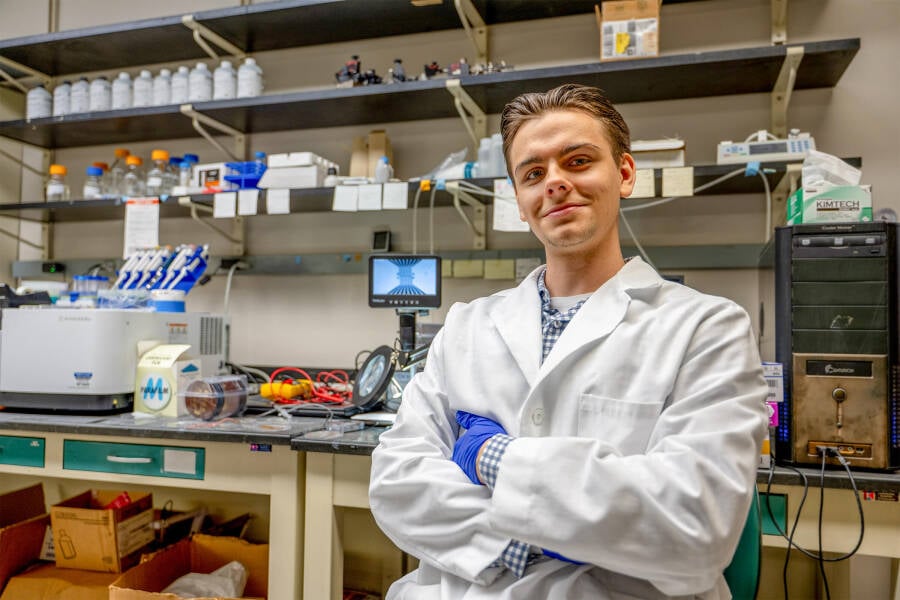
On a quiet March evening inside the University of Illinois Chicago’s Microfluidics Lab, Julian Olszewski reaches a powerful moment worth celebrating. After hours of meticulous effort to deposit a conductive polymer onto synthetic paper, Olszewski —
a sophomore mechanical engineering major — finally captures the result he’s been chasing.
by Daniel P. Smith

UIC sophomore Kathryn Hogue poses in front of preserved paintings in Venice, Italy, as part of her undergraduate research. Her work is supported by the Robert Munman Award for Student Research in Art History. (Photo courtesy of Kathryn Hogue.)
Redefining
Research
While student research is often viewed as the domain of high academic achievers, STEM fields or upper-division coursework, UIC is intentionally broadening access and challenging convention. The reason? Available data has increasingly linked undergraduate academic research experience to increased student retention, graduation rates and long-term success across demographics and disciplines.
Kathryn Hogue, a sophomore art history major in the College of Architecture, Design and the Arts, and Honors College student, embodies UIC’s intensifying institutional focus on undergraduate research.
For Hogue, research didn’t happen under a microscope, but within the museums of Venice, Italy. Supported by the Robert Munman Award for Student Research in Art History, Hogue spent her summer examining how centuries of conquest influenced Venice’s efforts to preserve its artistic culture and heritage.
“My research experience not only intensified my passion for art history and my desire to work in a museum, but it showed me how research can be aligned with passion and lead to new knowledge,” Hogue says.
By placing a sophomore in the heart of Venetian archives, UIC demonstrates that the identity of a “scholar” is not a post-graduate destination. Rather, it is a mindset cultivated early in one’s academic career.
For Hogue, research didn’t happen under a microscope, but within the museums of Venice, Italy.

Research as Service
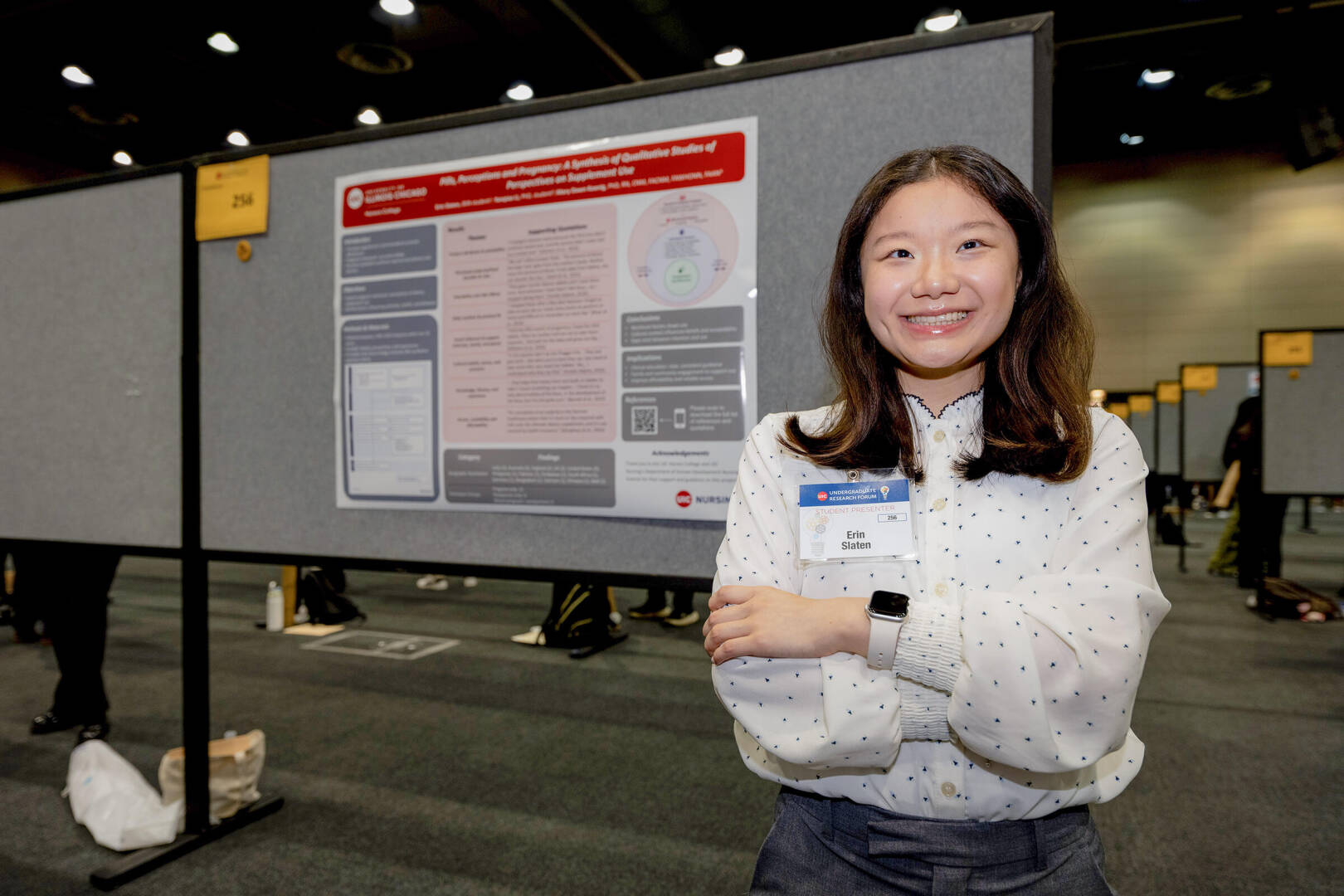
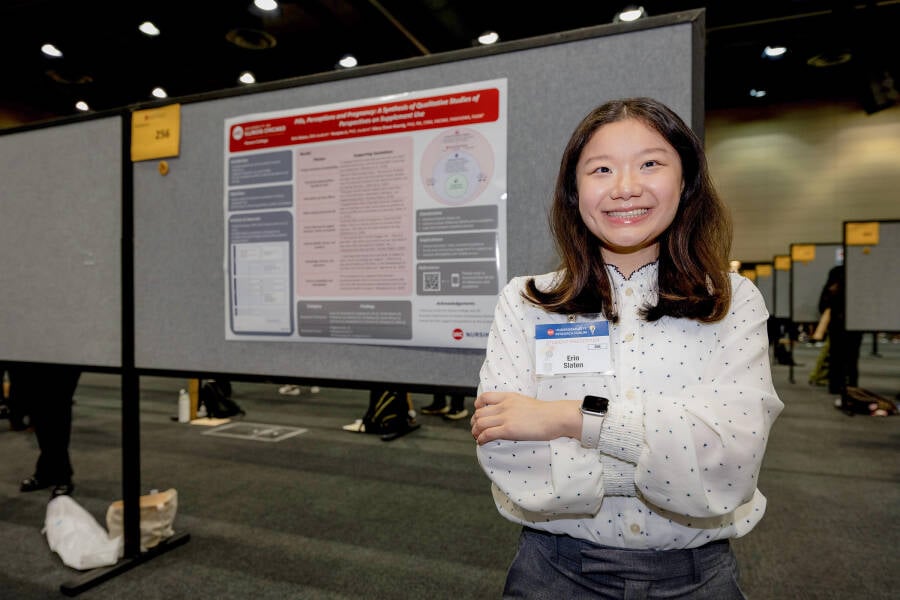
Erin Slaten, a UIC senior in the College of Nursing, poses with her research presentation on the effect of using supplements while pregnant at this year’s Undergraduate Research Forum (URF). (Photo by Anthony Jackson.)
When research moves out of the abstract and into the community, it becomes a powerful tool for public health and social equity. This is where the work of senior College of Nursing and Honors College student Erin Slaten comes in.
Supported by an Honors College Research Grant, Slaten, a first-generation college student, has been compiling the lived experiences of mothers using supplements during pregnancy. Her work did not stop in Chicago, though, as a study abroad trip to Rwanda provided her with a global perspective on the cultural and familial barriers to maternal care.
Slaten’s community-engaged research is an avenue to greater public impact informed by cultural competence. It’s inspiring her prospective career as a neonatal nurse practitioner.
“Because of my research, I feel I know the ins and outs of maternal-child health on a more holistic level,” says Slaten, who presented her findings at the UIC 2026 Undergraduate Research Forum in April after receiving the Honors College Gloria Flaherty Research Scholarship. She hopes to present at the 51st Midwest Nursing Research Society Annual Research Conference next year in Michigan.
Support and Accessibility
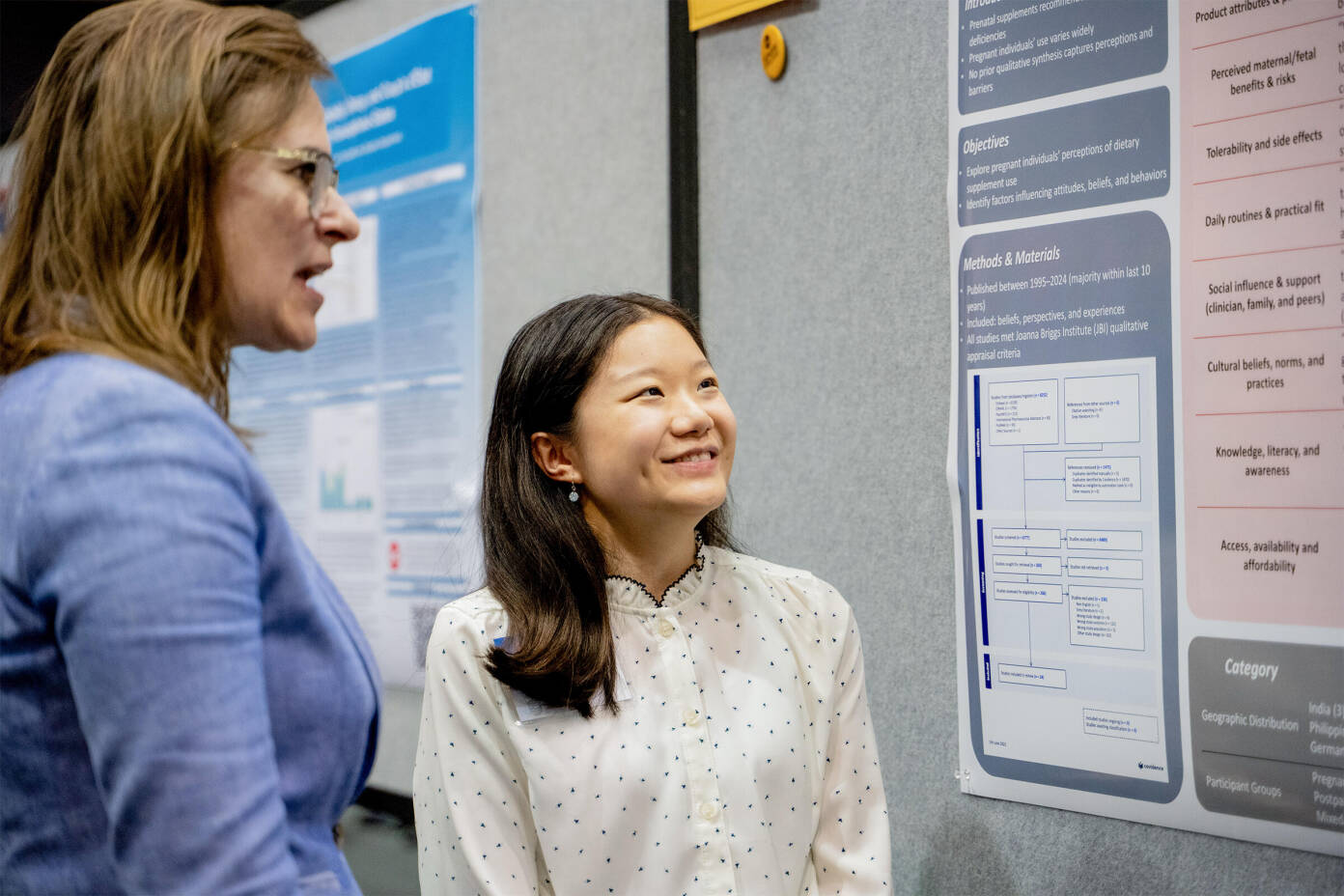
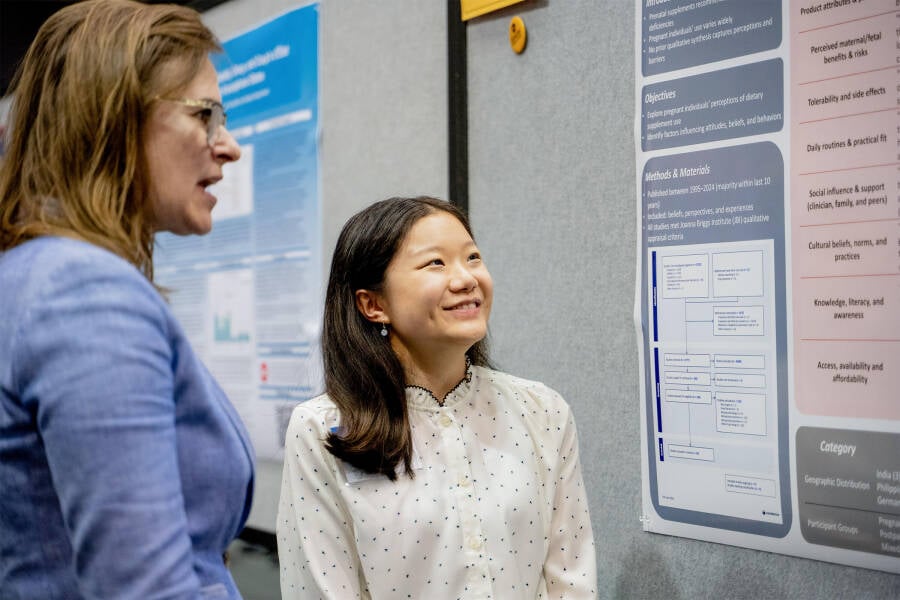
Slaten, right, with a volunteer judge at URF. (Photo by Anthony Jackson.)
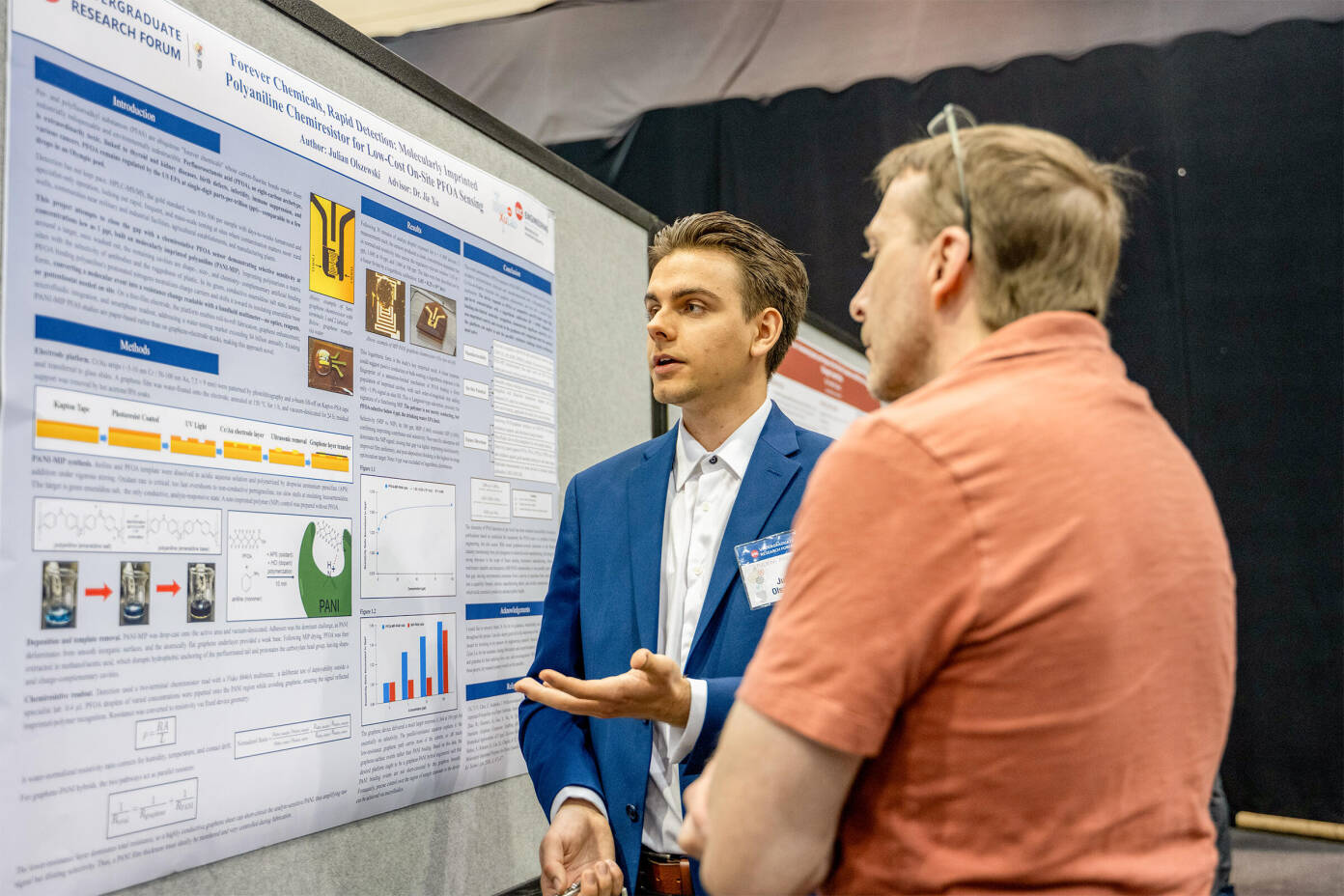
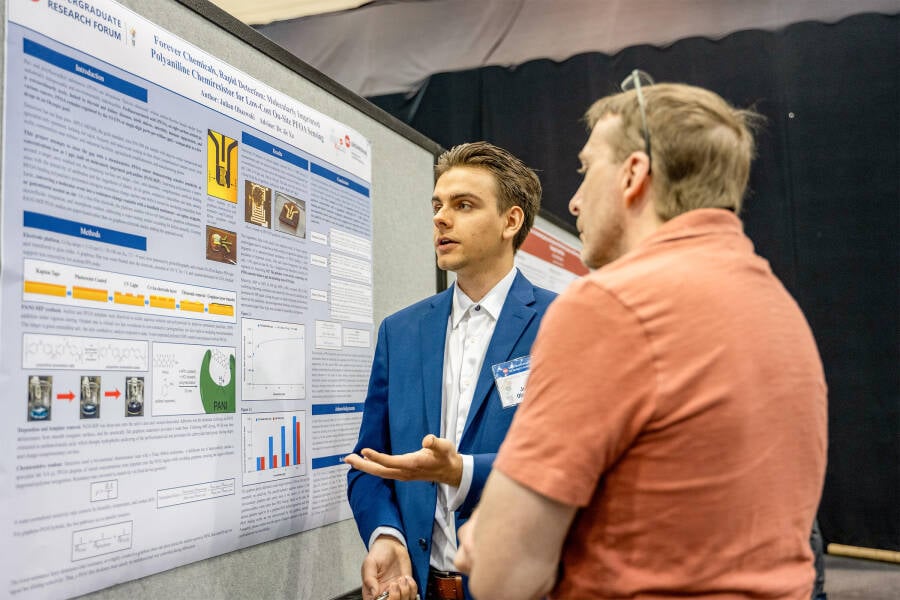
Olszewski, left, explains his research to a volunteer judge at URF. (Photo by Anthony Jackson.)
UIC’s Undergraduate Research Hub (URH) helps to turn aspirations into reality, supporting any student who wants to access the benefits of research.
The URH acts as a bridge, connecting students with faculty mentors and a vibrant community of innovators. It also manages the Chancellor’s Undergraduate Research Award, which allows students to earn an income as research assistants.
Olszewski joined the Microfluidics Lab after independently reaching out with his ideas to Jie Xu, an associate professor in the Department of Mechanical and Industrial Engineering. The Chancellor’s Award allowed him to dedicate sustained time to multiple research projects over the following year.
“Receiving that award allowed me to more fully immerse myself in my studies and my research,” Olszewski says.
The Collaborative Ecosystem
In the Microfluidics Lab, Xu hosts as many as eight undergraduate researchers at a time. He views them not as assistants, but as energetic collaborators following their curiosity and tackling unanswered questions.
“For undergraduates, research at this stage in their lives feels empowering and highlights the potential impact they might have,” Xu says.
A collaborative ecosystem of institutional support and private philanthropy unlocks these dynamic opportunities for undergraduates. At UIC, donations to research funds are “force multipliers.”
Philanthropic support has a direct impact on the development of undergraduates as well as the compelling investigations they are pursuing. Scholarships and stipends reduce financial strain, allow students to dedicate themselves to inquiry earlier in their academic careers and ensure students from diverse backgrounds can participate in research. Funding also allows labs like Xu’s to take on more students and undergraduates like Hogue and Slaten to travel abroad and bring global insights back to Chicago.
Pursuing Solutions and Brighter Futures
For Olszewski, the ultimate goal isn’t simply a published paper or résumé booster. He envisions a difference-making career in environmental monitoring.
Working on challenging products in the Microfluids Lab, Olszewski says, has provided mentorship and belonging and enabled him to apply the “systems thinking” taught in his engineering courses to real-world problems affecting human health. It has also exposed him to novel, innovative research technologies and nurtured his professional and personal ambitions to uplift humanity.
“It’s not enough for me just to complete classes,” says Olszewski, who presented his research at UIC’s annual Undergraduate Research Forum on April 21. “I want to push closer to practical applications to something we could actually use. That’s what animates my work ethic.”
Undergraduate research has the potential to enter the world and create significant impact. At the same time, it elevates the experience of students and fuels their futures. At UIC, this work is happening every day — one experiment, one interview and one archive at a time.
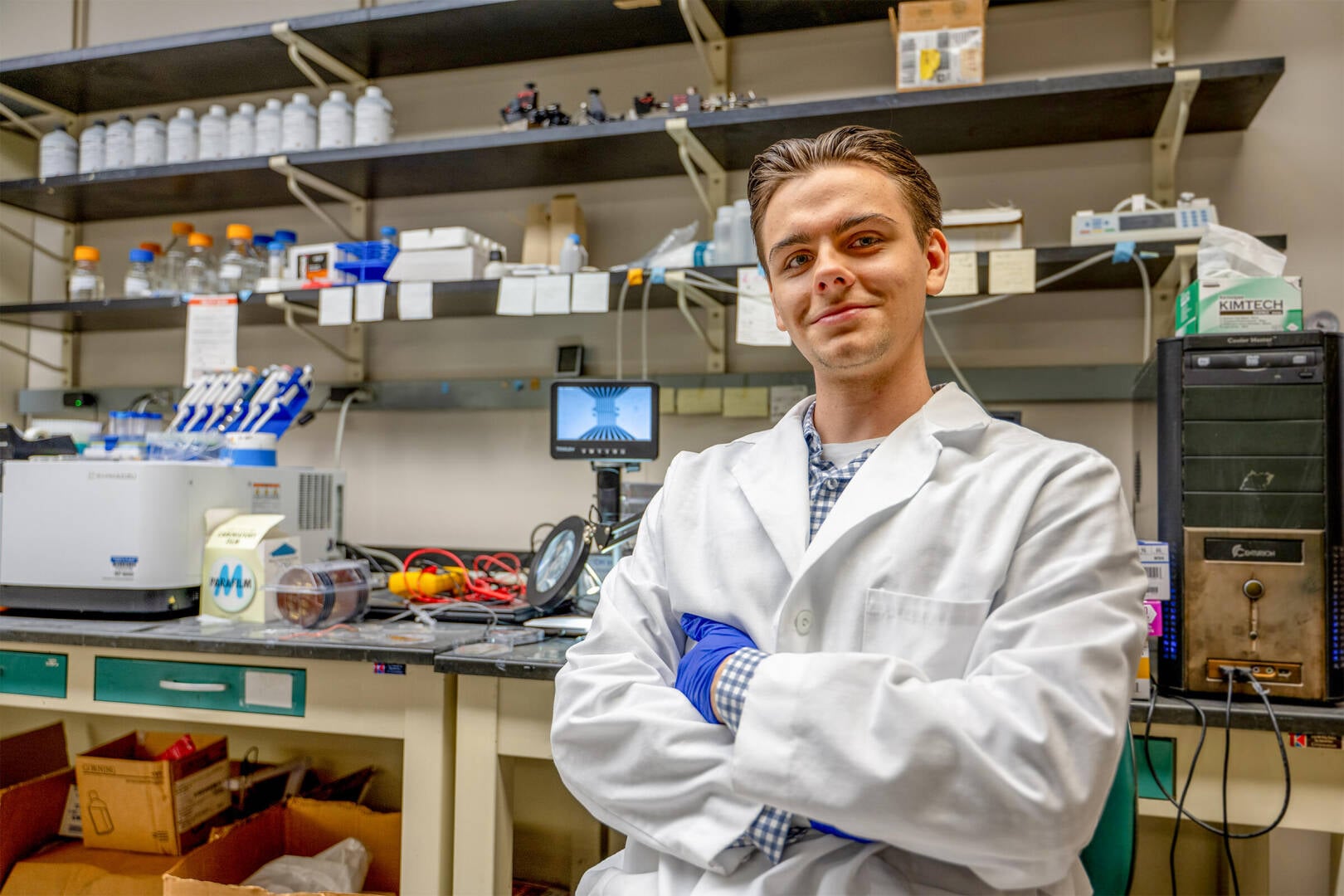
Olszewski at his work station in the Microfluidics Lab. (Photo by Anthony Jackson.)
Here’s how you can support student research at UIC:
Visit give.uic.edu
Type “research” into the search bar
Make a donation to an area you care about
Learn more about UIC research at UIC Today


UIC Unlocks Powerful Opportunities for Undergraduate Research
Discovery
Starts
Here
It is early — “very early,” Olszewski admits — but his customized solution could eventually improve sensing techniques that identify contaminants in water, thereby spurring interventions and reducing adverse health outcomes. “At least, that’s the dream,” he says. “I want the technology to become practical enough to protect public health.”
Olszewski’s discovery exemplifies what undergraduates can achieve when their enthusiasm and drive is applied in research settings. Financial support for undergraduate research ensures research opportunities are accessible to all undergraduate students. This is especially meaningful at UIC, where half of undergraduates are the first in their families to attend college and 56% demonstrate significant financial need. Grants, scholarships and awards expand students’ capacity to conduct research, giving them the flexibility to engage in experiential learning alongside their other commitments.
By moving beyond the lecture hall and into labs, clinics, community settings and archives, undergraduates sharpen their technical skills, gain newfound confidence and expand possibilities. The successes of Olszewski and others aren’t merely field-work wins; they are keys to unlocking a healthier, more vibrant future.
On a quiet March evening inside the University of Illinois Chicago’s Microfluidics Lab, Julian Olszewski reaches a powerful moment worth celebrating. After hours of meticulous effort to deposit a conductive polymer onto synthetic paper, Olszewski —
a sophomore mechanical engineering major — finally captures the result he’s been chasing.
by Daniel P. Smith
Redefining
Research
While student research is often viewed as the domain of high academic achievers, STEM fields or upper-division coursework, UIC is intentionally broadening access and challenging convention. The reason? Available data has increasingly linked undergraduate academic research experience to increased student retention, graduation rates and long-term success across demographics and disciplines.
Kathryn Hogue, a sophomore art history major in the College of Architecture, Design and the Arts, and Honors College student, embodies UIC’s intensifying institutional focus on undergraduate research.
For Hogue, research didn’t happen under a microscope, but within the museums of Venice, Italy. Supported by the Robert Munman Award for Student Research in Art History, Hogue spent her summer examining how centuries of conquest influenced Venice’s efforts to preserve its artistic culture and heritage.
“My research experience not only intensified my passion for art history and my desire to work in a museum, but it showed me how research can be aligned with passion and lead to new knowledge,” Hogue says.
By placing a sophomore in the heart of Venetian archives, UIC demonstrates that the identity of a “scholar” is not a post-graduate destination. Rather, it is a mindset cultivated early in one’s academic career.
For Hogue, research didn’t happen under a microscope, but within the museums of Venice, Italy.

Erin Slaten, a UIC senior in the College of Nursing, poses with her research presentation on the effect of using supplements while pregnant at this year’s Undergraduate Research Forum (URF). (Photo by Anthony Jackson.)
When research moves out of the abstract and into the community, it becomes a powerful tool for public health and social equity. This is where the work of senior College of Nursing and Honors College student Erin Slaten comes in.
Supported by an Honors College Research Grant, Slaten, a first-generation college student, has been compiling the lived experiences of mothers using supplements during pregnancy. Her work did not stop in Chicago, though, as a study abroad trip to Rwanda provided her with a global perspective on the cultural and familial barriers to maternal care.
Slaten’s community-engaged research is an avenue to greater public impact informed by cultural competence. It’s inspiring her prospective career as a neonatal nurse practitioner.
“Because of my research, I feel I know the ins and outs of maternal-child health on a more holistic level,” says Slaten, who presented her findings at the UIC 2026 Undergraduate Research Forum in April after receiving the Honors College Gloria Flaherty Research Scholarship. She hopes to present at the 51st Midwest Nursing Research Society Annual Research Conference next year in Michigan.
Research as Service
Slaten, right, with a volunteer judge at URF. (Photo by Anthony Jackson.)
Olszewski, left, explains his research to a volunteer judge at URF. (Photo by Anthony Jackson.)
UIC’s Undergraduate Research Hub (URH) helps to turn aspirations into reality, supporting any student who wants to access the benefits of research.
The URH acts as a bridge, connecting students with faculty mentors and a vibrant community of innovators. It also manages the Chancellor’s Undergraduate Research Award, which allows students to earn an income as research assistants.
Olszewski joined the Microfluidics Lab after independently reaching out with his ideas to Jie Xu, an associate professor in the Department of Mechanical and Industrial Engineering. The Chancellor’s Award allowed him to dedicate sustained time to multiple research projects over the following year.
“Receiving that award allowed me to more fully immerse myself in my studies and my research,” Olszewski says.
Support and Accessibility
In the Microfluidics Lab, Xu hosts as many as eight undergraduate researchers at a time. He views them not as assistants, but as energetic collaborators following their curiosity and tackling unanswered questions.
“For undergraduates, research at this stage in their lives feels empowering and highlights the potential impact they might have,” Xu says.
A collaborative ecosystem of institutional support and private philanthropy unlocks these dynamic opportunities for undergraduates. At UIC, donations to research funds are “force multipliers.”
Philanthropic support has a direct impact on the development of undergraduates as well as the compelling investigations they are pursuing. Scholarships and stipends reduce financial strain, allow students to dedicate themselves to inquiry earlier in their academic careers and ensure students from diverse backgrounds can participate in research. Funding also allows labs like Xu’s to take on more students and undergraduates like Hogue and Slaten to travel abroad and bring global insights back to Chicago.
The Collaborative Ecosystem
Here’s how you can support student research at UIC:
Visit give.uic.edu
Type “research” into the search bar
Make a donation to an area you care about
Learn more about UIC research at UIC Today
Olszewski at his work station in the Microfluidics Lab. (Photo by Anthony Jackson.)
For Olszewski, the ultimate goal isn’t simply a published paper or résumé booster. He envisions a difference-making career in environmental monitoring.
Working on challenging products in the Microfluids Lab, Olszewski says, has provided mentorship and belonging and enabled him to apply the “systems thinking” taught in his engineering courses to real-world problems affecting human health. It has also exposed him to novel, innovative research technologies and nurtured his professional and personal ambitions to uplift humanity.
“It’s not enough for me just to complete classes,” says Olszewski, who presented his research at UIC’s annual Undergraduate Research Forum on April 21. “I want to push closer to practical applications to something we could actually use. That’s what animates my work ethic.”
Undergraduate research has the potential to enter the world and create significant impact. At the same time, it elevates the experience of students and fuels their futures. At UIC, this work is happening every day — one experiment, one interview and one archive at a time.